On 23 February 2017, I had the pleasure of giving a lecture at the Collège de France at the invitation of Professor Carlo Ossola, as part of the seminar organised by the Chair of Modern Literatures of Neo-Latin Europe, the theme of which was ‘The Other Side of the Visible’ (‘L’envers du visible’)
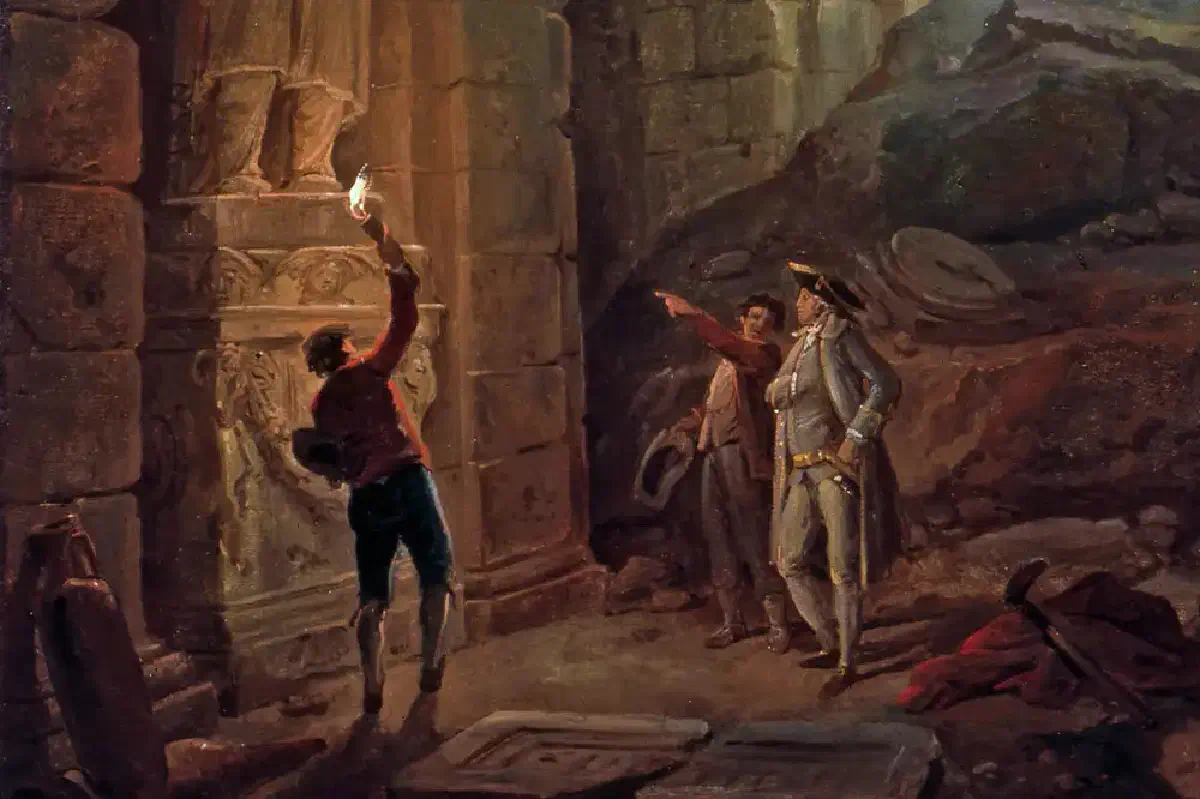
Neoclassicism is sometimes reduced to its aspiration for the regularity of lines and the visibility of figures, as if it were founded on an equivalence between light and beauty. Yet far from shunning or fearing shadow, European Neoclassicism, rich in variations and contradictions, confronted it and, in some cases, welcomed it into its figurative system. The renewed appreciation of the nocturnal captivated many artists and writers for whom darkness, far from being perceived as the negation of beautiful form, was endowed with a foundational and creative function. From Piranesi to Hubert Robert, the depths of underground passages and catacombs stimulated the poetic and artistic imagination of the waning century. In Italy, Alessandro Verri skilfully combined the cult of classical beauty with a nocturnal setting in his novels Le Avventure di Saffo (1781) and Le Notti romane (1792–1804). His approach, which involves the hybridisation of images and motifs drawn from the antiquarian and artistic culture of his time, is underpinned by the conviction that darkness is capable of bringing to light certain truths forgotten by men enamoured of rational clarity (the depths of the abysses of time, the transience of civilisations, the Promethean arrogance of the sciences). My aim here has been to define the nature of Verri’s experimental neoclassicism in his mature works, whilst situating them within the context of the development of the fine arts in Italy and Europe at the turn of the 18th and 19th centuries.
The text of my paper was published under the title « Un néoclassicisme de l’ombre. Les nocturnes d’Alessandro Verri », in Lettere italiane, nᵒ 3, vol. 70, 2018, p. 504‑533.